
Do Weight-Loss Drugs Cause Hair Loss? Part 3 – Researching the Risk
The latest science behind GLP-1 medications, scalp shedding, possible mechanisms and recovery
Evidence review and consumer guide | Last reviewed: July 2026
What the latest research actually shows
Short answer: A large 2026 study found a real but modest increased risk of hair loss with GLP-1 medicines — that’s not the same as proof the drug directly causes it.
In July 2026, The BMJ published a target-trial emulation examining the risk of non-scarring alopecia in adults with type 2 diabetes who initiated GLP-1 receptor agonists. The study used large healthcare datasets and compared users with people starting two other classes of glucose-lowering medicine: DPP-4 inhibitors and SGLT-2 inhibitors.
The researchers reported a higher relative risk of non-scarring alopecia among GLP-1 receptor agonist users. The increase was approximately 68% compared with DPP-4 inhibitors and approximately 37% compared with SGLT-2 inhibitors. The exact interpretation depends on the analytical comparison and follow-up period, but the direction of the association was consistent enough to warrant clinical attention.
This study is important because it moves the discussion beyond anecdote. It does not, however, resolve the mechanism. Observational datasets can identify patterns in real-world care, but they cannot fully control for every difference between treatment groups — including the amount and speed of weight loss, diet quality, treatment adherence, underlying illness or the likelihood of seeking help for hair changes.
A 2026 systematic review also concluded that accumulating pharmacovigilance and clinical evidence suggests an increased hair-loss signal with some GLP-1-based therapies, particularly semaglutide and tirzepatide. Rapid weight loss emerged as a plausible contributor, and women appeared disproportionately represented in reports. The review nevertheless emphasised the limitations of the evidence and the need for studies designed specifically around hair outcomes.
Relative risk versus absolute risk
The most misleading claim circulating online is that “69% of GLP-1 users lose hair.” That is not what the BMJ study found.
A relative increase of 69% means that the rate in one group was approximately 1.69 times the rate in the comparison group. It does not mean that 69 out of every 100 users developed hair loss. When the starting rate of an event is low, even a substantial relative increase can still correspond to a small absolute increase.
The BMJ analysis described absolute event rates in the range of only several cases per 1,000 person-years, depending on the comparator and analysis. Therefore, the correct interpretation is that the risk appears higher than with certain alternative diabetes medicines, while the absolute probability for an individual remains relatively low.
A scientifically accurate formulation is: “One large study found roughly a 68–69% relative increase in diagnosed non-scarring alopecia compared with DPP-4 inhibitors, although the absolute incidence remained low.”
What type of hair loss is being reported?
Short answer: Most people experience temporary, all-over thinning — not permanent bald patches — and the hair usually grows back.
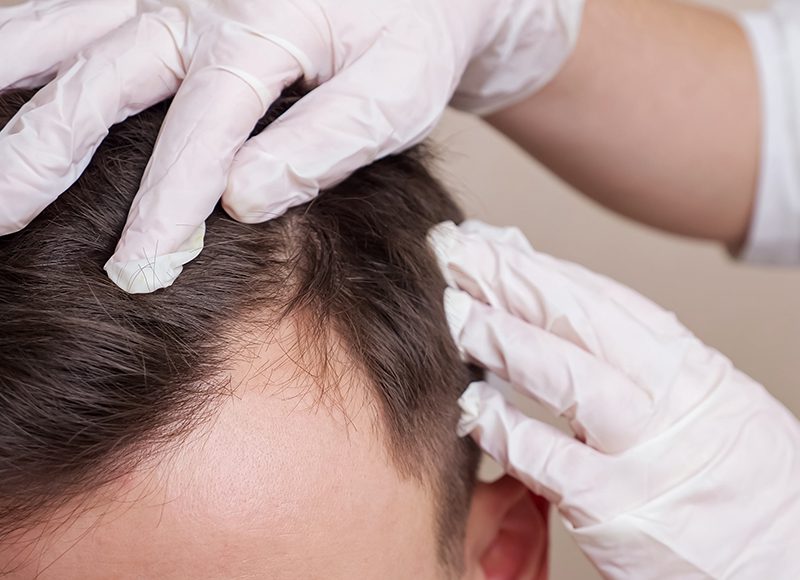
Most reports describe diffuse, non-scarring scalp shedding rather than sharply defined bald patches or destructive scalp disease. The leading clinical explanation is telogen effluvium.
The normal hair cycle
Scalp follicles cycle through anagen, catagen, telogen and exogen. Anagen is the active growth phase and can last for years. Catagen is a short regression phase. Telogen is a resting phase, and exogen is the release of the resting hair.
At any one time, most scalp hairs are in anagen and a minority are resting. Telogen effluvium occurs when a physiological trigger shifts an unusually large number of follicles from growth into rest. The hairs are not necessarily shed immediately. Visible loss commonly becomes apparent around two to four months after the triggering event.
Why the delay matters
A person may begin shedding months after starting medication or after the period of fastest weight loss. That delay can make causation confusing. The hair appearing in the shower today may reflect a biological change that happened several months earlier.
Telogen effluvium is usually non-scarring: the follicular structure and stem-cell reservoir remain present. Once the trigger resolves, follicles can re-enter anagen, although visible recovery takes time.